Most companies begin sourcing for an AI engineer by searching the literal term "AI Engineer" in LinkedIn Recruiter or an ATS. That approach systematically misses the majority of the relevant labor market.
A recent analysis of 4,548 resumes belonging to "AI top talent" — people who have held AI-related roles at Google, OpenAI, Anthropic, Meta, Microsoft, Amazon, Apple, or NVIDIA — makes the point with a hard number: only 8.7% of this group actually carried an "AI/ML engineering" title when they entered their first top company. Title-based search alone filters out roughly nine of every ten people who are already doing this work.
The original report was published by Lexiom, a company that sells an AI-driven sourcing tool, so it's worth reading with that lens — several of its examples double as a pitch for its own product. Setting that aside, the underlying data on entry points, age, skill clustering, attrition, and prioritization is genuinely useful. This piece pulls the numbers apart, adds independent analysis on why the patterns look the way they do, and reframes the recommendations so they're useful regardless of which sourcing tool you use.
Job Titles Undercount This Population
71.9% of this group studied CS, AI, or Data Science as undergraduates — no surprise there. The surprise shows up when you look at the title they actually held on the day they joined a top company:
8.7% entered under an "AI/ML engineering" title
30.2% entered as a researcher or under a PhD-track title — 3.5x more common than the "AI/ML engineering" label
Only 9.5% actually hold a PhD
Research and PhD-Track Titles Function as Internal Leveling Labels, Not Credential Requirements
Comparing these two figures shows a substantial gap: 30.2% entered under a "PhD-track" title, while only 9.5% hold an actual PhD. Top companies have effectively repurposed "Researcher" or "Scientist" as an internal leveling label rather than a credential requirement — a large share of people carrying that title never completed a doctorate.
Implication for Title-Based Screening
If your sourcing logic or your recruiter's boolean string quietly assumes "research-track role = PhD required," you're not filtering out people who lack the skill. You're filtering out people whose internal title doesn't match your external assumption about what that title should require.
Recommendation
Treat "Researcher" and "Applied Scientist" titles as an indicator of skill cluster rather than a proxy for formal credentials, and verify the underlying work — published research, benchmark results, shipped models — directly.
This also explains why a plain "AI Engineer" title search fails structurally: it assumes this population has always worn one consistent label, when in practice their entry ticket might read "Research Scientist," "ML Engineer," or "Software Engineer." What's actually consistent across the group isn't the title — it's the skill cluster covered in Section 3.
Entry Into Top Companies Is Concentrated Early in the Career
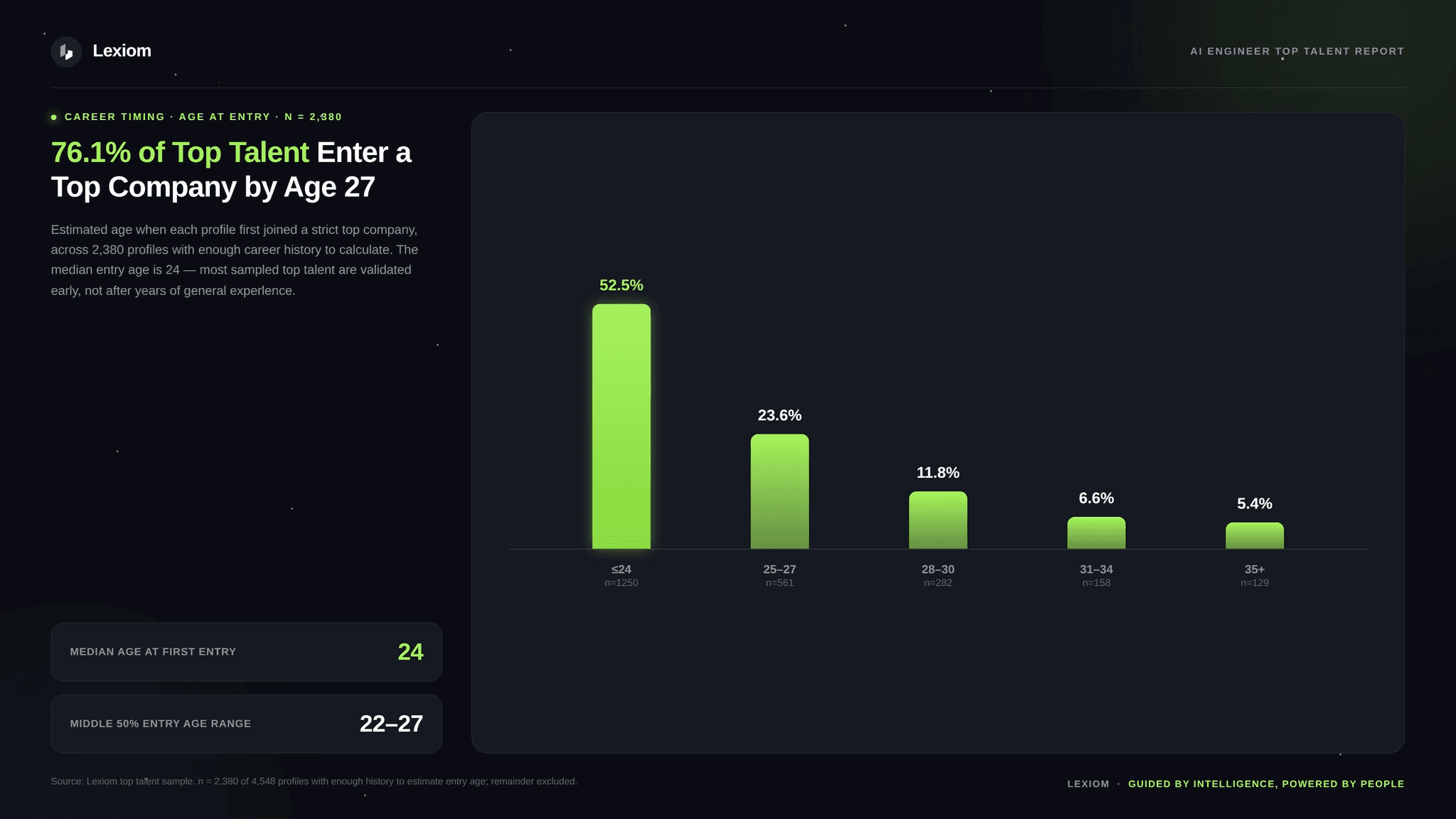
Half of this population landed their first top-company offer by 24. Three-quarters got there by 27. The median age at first entry is 24, with the middle 50% falling between 22 and 27. And today, the group's current median age is still only 32 — this is not a population that ages out of "top talent" status; it's one that gets tagged early and stays tagged.
Implication for Pipeline Investment
The takeaway here is more specific than "AI talent is young." The real screening window for top-tier AI talent sits in campus recruiting and the first 1–2 years out of school, not in the 3–5-year lateral-hire market. If a company treats new-grad and internship pipelines as a lower-priority backup channel and puts its sourcing budget into the lateral market instead, it's competing for a population that has already been validated repeatedly and is the most expensive to move — while missing the window before anyone tagged them at all. For budget-constrained teams, building the ability to identify early top-company signal in a new grad — rather than waiting for a resume that already has one — is likely a better return than outbidding competitors for 3–5-year lateral hires.
Skill Composition: A Common Baseline and a Narrower Set of Differentiating Signals
This is the densest part of the dataset, and the most useful one for writing a job description that actually matches the market.
Baseline Skills Are Necessary but Not Differentiating
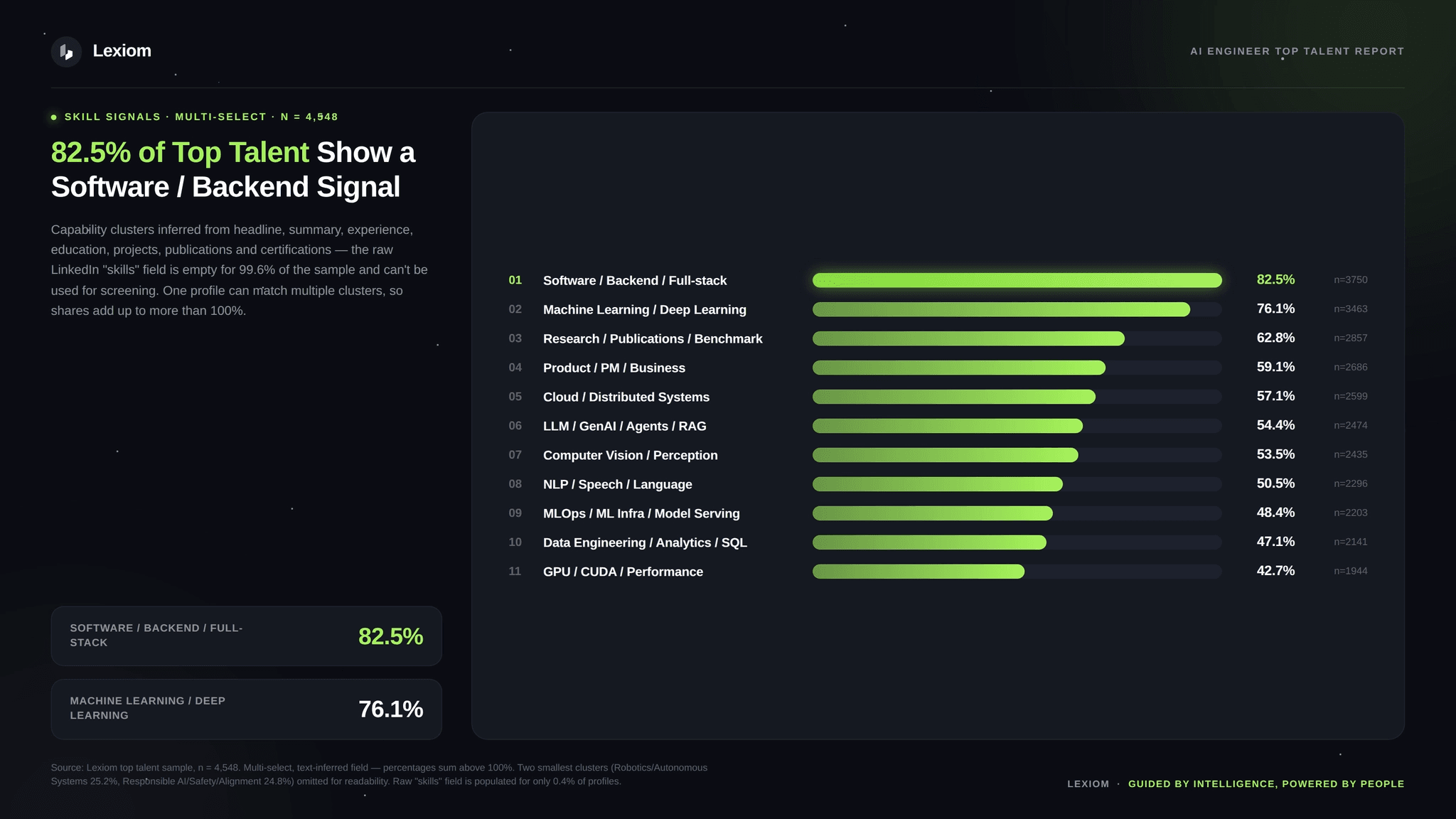
Software/backend skill (82.5%) and ML fundamentals (76.1%) are close to universal in this population. Screening on either one, alone, won't separate a strong candidate from an average one — almost everyone clears that bar. The signals that actually split the population sit in the middle of the ranking: cloud/distributed systems (57.1%) and LLM/Agent/RAG (54.4%) each show up in only just over half of profiles. That's the real dividing line.
Explanation: Backend Engineering as a Transition Path Into AI Roles
This ranking is also the best explanation for why backend-oriented engineers move into AI roles so cleanly: they already carry the software foundation that's nearly universal in this population, so the only additional layer they need is systems depth — cloud, distributed training, LLM/RAG serving — rather than building software engineering fundamentals from zero.
Demonstrated Output Is a More Common Signal Than Infrastructure Fluency
The more counterintuitive result: "Research / Publications / Benchmarks" (62.8%) appears more often in these resumes than "Cloud / Distributed Systems" (57.1%) — and more often than LLM/RAG skills too. Most hiring teams default to a mental model where "top AI talent" means "someone who can operationalize models at scale." The data suggests something adjacent but different: at this tier, having shipped and validated something — a paper, a benchmark result, an open-source tool people actually used — is a more common signal than fluency with any specific infrastructure stack.
Implication for Interview Design
Instead of testing tool-chain trivia (can you deploy on Kubernetes, do you know this specific serving framework), ask the candidate to walk through one project they owned end-to-end, with a verifiable outcome — a published result, a production launch, an open-source project with real usage.
Recommendation
A candidate profile weighted toward demonstrated output (papers, benchmark results, shipped open-source work) and light on infrastructure keywords should not be discounted for a systems-heavy role; the ability to produce a verifiable result may be the more predictive signal.
Frontend Engineering Is Underrepresented in This Skill Distribution
The report is explicit here, and it matches the skill-cluster data: core frontend competencies (interaction design, UX) don't overlap much with this skill distribution. That doesn't mean frontend engineering is unimportant to AI products — it means the "AI Engineer" archetype in this dataset skews toward backend, data, and infrastructure. A job description that blends "AI product manager / AI product engineer" and "AI infrastructure engineer" into one posting is very likely to mismatch candidates at the screening stage, because those are two different skill clusters wearing the same job title.
Post-Departure Trajectories
33.5% of this population has already left the top-company list — and it's a pool most recruiters ignore by default. Of those who left: 72% are still in technical or research roles, and 40.6% left within just the last 3 years.
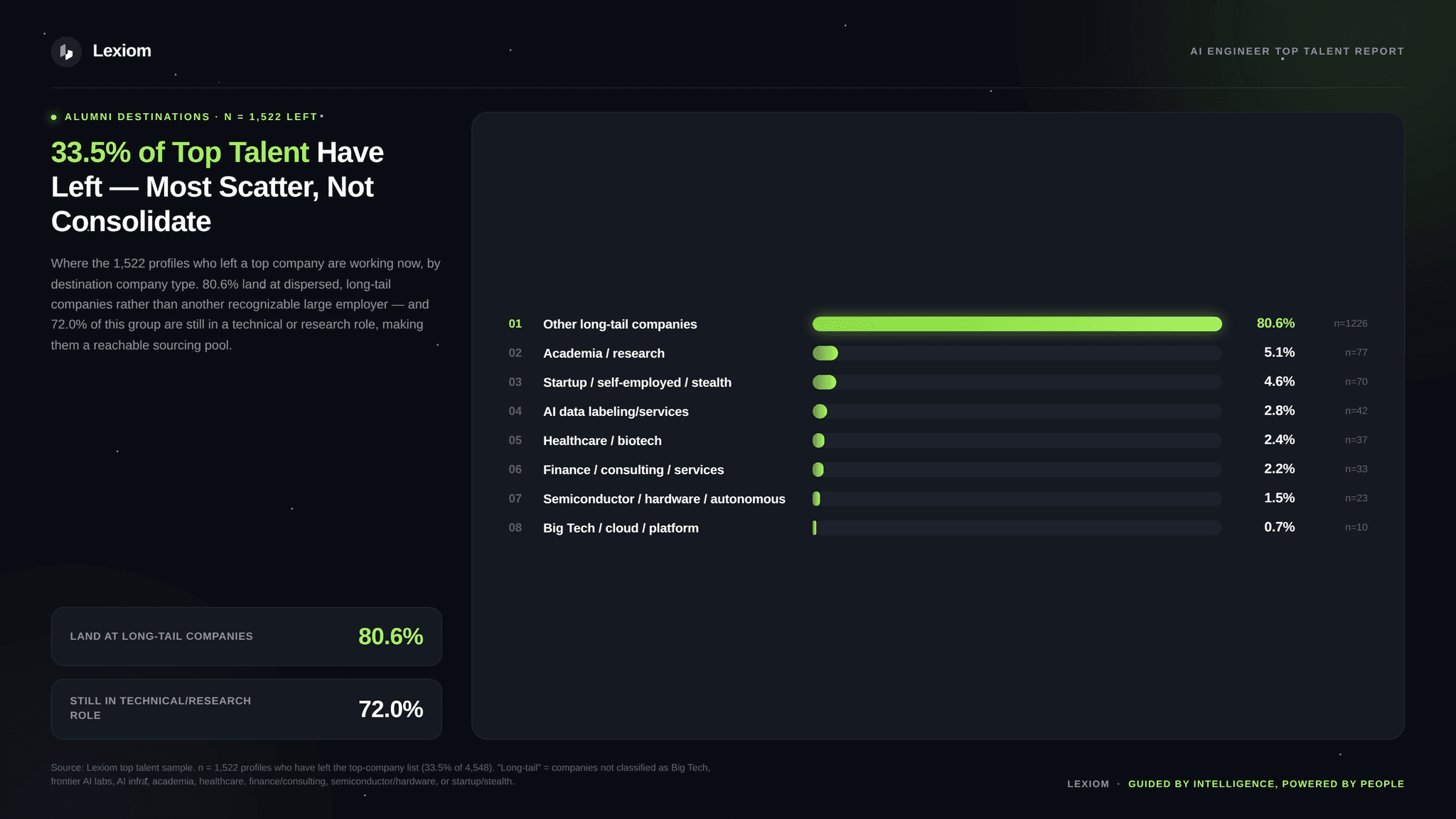
The figure of note is the final row: only 0.7% of leavers landed at another Big Tech / cloud / platform company.
Once this population exits the top-company track, the "boomerang" rate back into an equivalent-tier company is close to zero. Their next move is, in most cases, a step out of the conventional ladder entirely — not a lateral move to a comparable brand.
That's best read as a revealed preference, not a fallback. People who can move between top companies at will, by definition, still have that option available when they leave. If they choose not to take it, the departure is more likely a deliberate trade — equity upside, autonomy, mission fit — than a sign they couldn't land another big-name offer. For smaller companies, the practical implication is direct: this candidate isn't settling for you because a bigger name wasn't available. They're choosing you after weighing the alternative. A pitch built around comp parity with Big Tech is answering a question they've probably already answered for themselves; a pitch built around equity, ownership, and decision-making latitude is answering the one they're actually asking.
Destination Company Size Follows a Bimodal Distribution
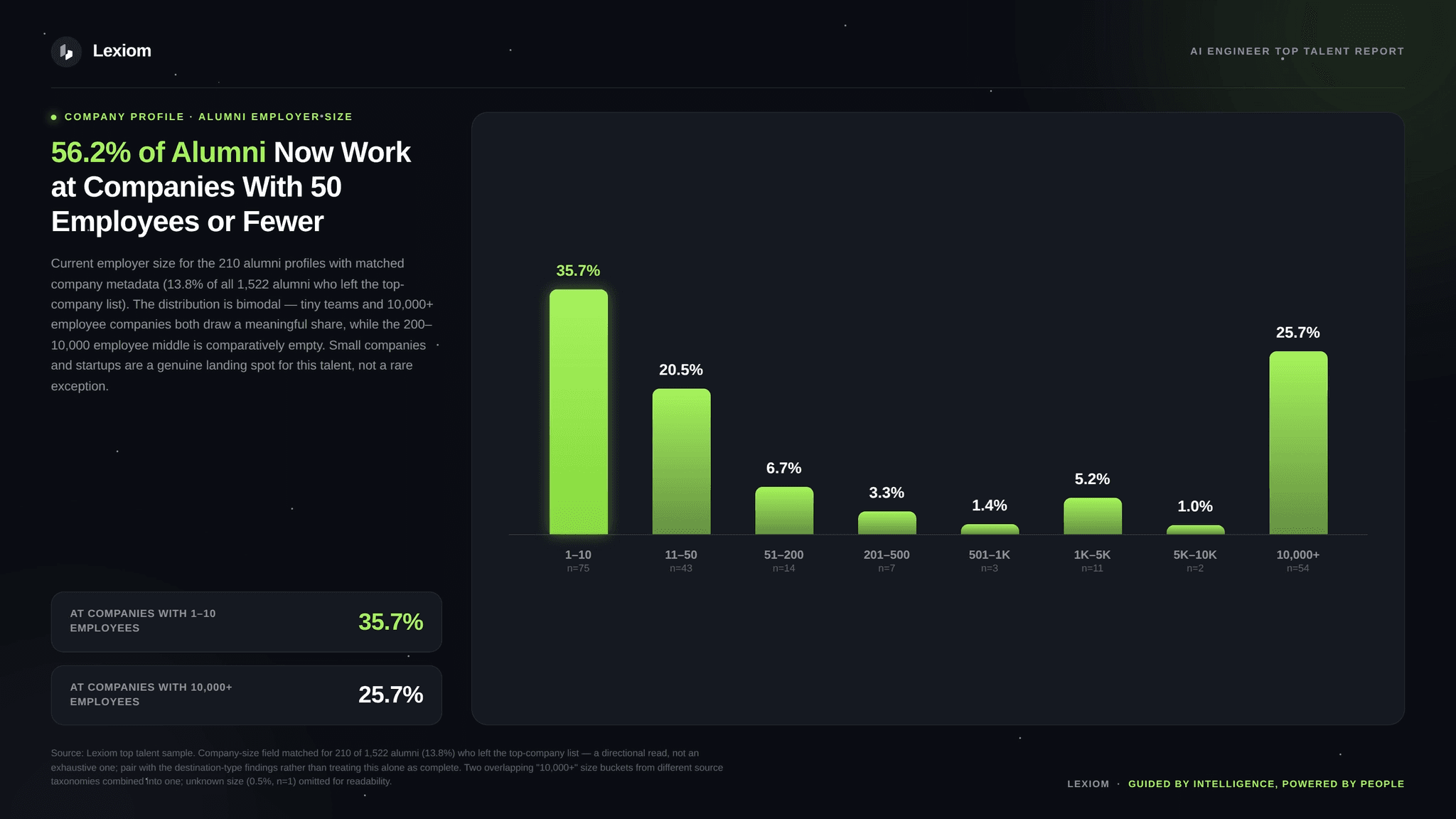
Note the sample size here: this size breakdown only covers the 210 departures (13.8% of all leavers) that could be matched to a new company's headcount, so treat it as directional rather than exact. With that caveat, the shape is striking: 35.7% of matched leavers landed at a company of just 1–10 people — not "a small company" in the vague sense, but an extremely early-stage team. Add the 11–50 bracket and 56.2% of matched leavers are at companies under 50 people. At the other end, 25.7% went to companies of 10,000+. The "normal-sized company" range in between — 51 to 10,000 employees — accounts for only 17.6%.
Interpretation: A Revealed Preference, Not a Fallback
This distribution is bimodal rather than linear, and the concentration at the smallest end is easy to overlook if the finding is summarized only as "half go to small companies." The concentration is specifically at the 10-person end of that range, not the 40-person end.
Recommendation
For an early-stage company concerned that top-company alumni will not consider a team of its size, this data suggests otherwise: the single most common destination for departing top-company talent is a team in the 1–10 person range, not a mid-sized, more conventional company.
Prioritization Under Budget Constraints
38.2% of this population (about 1,737 people) are "currently at a top company, repeatedly validated" — the strongest quality signal available, and also the most expensive and most contested. In parallel, 24.1% (about 1,096 people, 72% of all leavers) are alumni who left but stayed in technical or research roles — an equally validated signal, typically easier to reach. Overall, 51.2% of this population has worked at 2+ top companies, meaning mobility is already the norm for half the group.
✅ On a limited budget, prioritize alumni who left in the last 1–3 years and stayed in a technical role. Then move to repeatedly-validated current employees. The former costs less to reach and tends to convert better — they're validated, but not yet buried under a fresh wave of recruiter outreach the way a current employee is.
Operational Recommendations
Sourcing Methodology
A boolean string only matches the exact words you typed — phrase the same requirement differently, and a well-matched candidate slips past it. Rather than iterating on variations of "AI Engineer," search for the skill-cluster combination directly.
Example — hands-on LLM/infra skill signal, title-agnostic:
Lexiom's own writeup expresses this same logic as a natural-language query rather than a boolean string:
"Find engineers with hands-on LLM experience — model serving, distributed training, or CUDA — and core ML tooling, regardless of job title."
Example — Big Tech-to-startup AI transition:
And for the second pattern:
"Find research-track talent with publication, benchmark, or open-source signals who've since moved into large-scale model training or LLM work — regardless of which company they came from."
The two forms express the same underlying logic — a boolean string is exact-match, a natural-language query relies on the tool to generalize across phrasing. Whichever form you use, the method is the same: decide which skill combination you actually need, then decide what to search for — not the other way around.
Interview Design
Don't weight title or company logo as a proxy for quality. Verify the skill-cluster combination directly: has a research background actually shipped something into production? Has an infrastructure background actually run training or inference at real scale, or only read about it?
Pool Segmentation
Build candidate pools around a persona, not a single title — for example: Research-to-Production, AI Platform / ML Infra, and Applied LLM / Agent Builder. Each persona should get its own job description and its own interview bar; using one generic "AI Engineer" rubric across all three will systematically favor whichever persona your interviewers happen to be most familiar with.
Scenario-Based Sourcing Guidance
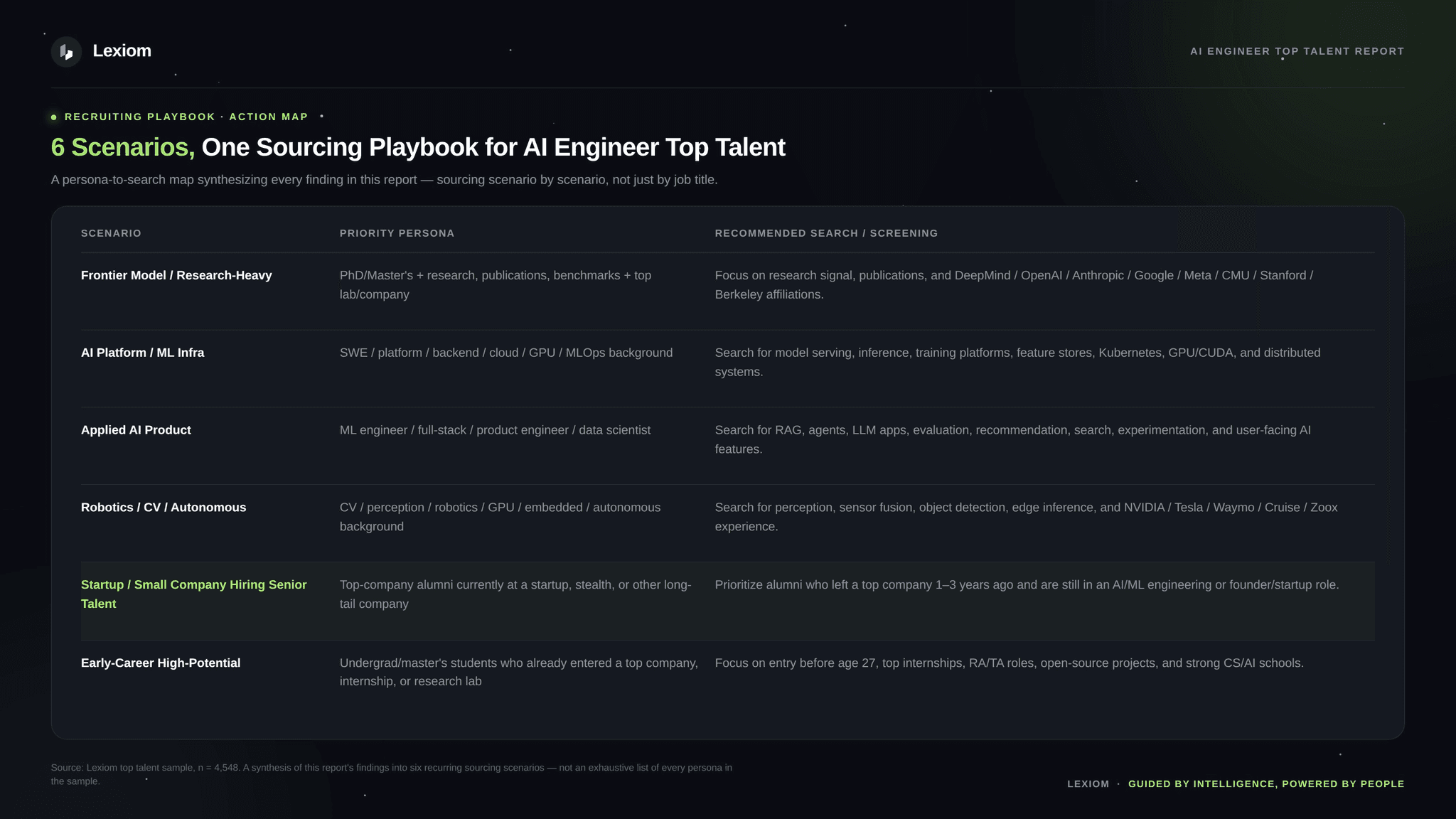
Scenarios Most Likely to Be Missed by Standard Screening
Across these six scenarios, "poaching a senior candidate for a startup" and "identifying early-career, high-potential candidates" are the two most likely to slip through a standard screen — neither depends on the candidate's current company name. One depends on the departure time window; the other depends on early signals of top-company entry. Both run opposite to the default approach of screening backward from current employer and degree.
One more distinction worth making explicit: don't treat "senior" as synonymous with "currently employed at a big company." A large share of this population entered top companies sideways, with 3–10 years of experience already behind them, via a research background or a software/platform-engineering transition. The entry point into the same senior candidate pool is not necessarily the big-company employee directory.
📋 About the data: "Top talent" refers to people who have worked in AI roles at leading companies such as Google, OpenAI, Anthropic, Meta, Microsoft, Amazon, Apple, or NVIDIA.
Conclusion
The sample here (Google, OpenAI, Anthropic, Meta, and similar U.S. companies) skews the specific numbers toward a Silicon Valley labor market — company-size distribution and destination-industry shares will likely look different in other regions, and should be discounted accordingly if you're applying this outside that context. But the structural findings are more likely to generalize: the mismatch between title and actual capability, the early-career screening window, skill combinations mattering more than any single skill, and the near-zero "boomerang" rate back into equivalent-tier companies after departure. Those are worth treating as a reference model when designing a sourcing strategy, even in a different market.
The real question was never "where do I find AI engineers." It's "what profile am I actually using to define one." Get the profile wrong, and no amount of tooling — smart or otherwise — will find the right person.